
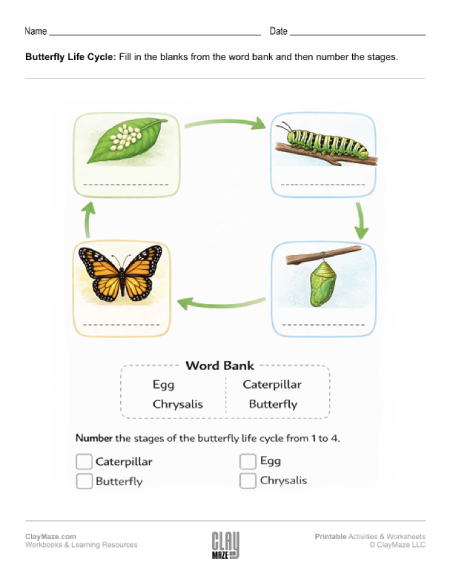
Help young learners explore how butterflies grow and change with this Butterfly Life Cycle worksheet for Grades 1–2. Students identify and sequence the four stages of a butterfly’s life using a clear, visual diagram and age-appropriate vocabulary.
This free worksheet helps students:
- Identify the stages of the butterfly life cycle
- Learn key science vocabulary such as egg, caterpillar, chrysalis, and butterfly
- Practice sequencing events in order
- Build foundational life science understanding
This worksheet includes a student page and a completed answer key, making it easy to use in classrooms, homeschool lessons, or independent science practice.
Download Printable PDFTry a few of our other Life Cycle Worksheets: Ladybug, Frog, or Bee.
Related Worksheets
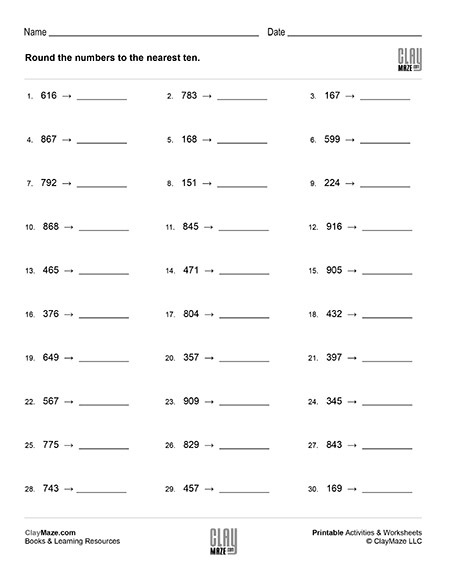
Rounding to the Nearest Ten Worksheets (3-Digit Numbers)
These worksheets give students plenty of practice with rounding to the nearest ten with 3‑digit numbers, helping them strengthen place‑value understanding. Each printable includes 30 problems with an answer key. These worksheets are ideal for classroom use, homework, or extra
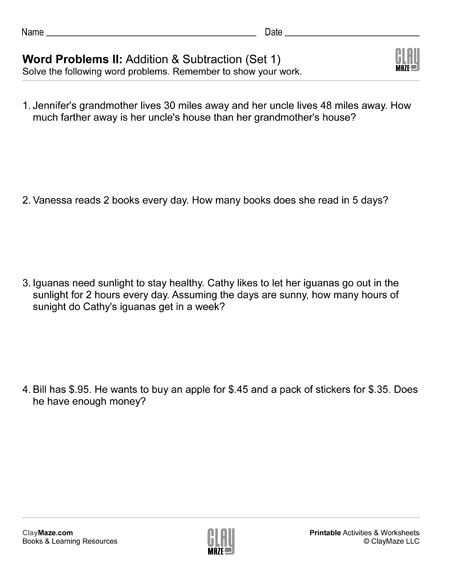
Word Problems I: Addition & Subtraction
These are sets of basic addition and subtraction word problems. The student should read through each problem thoroughly to answer the questions and be sure to show their work below each one. These are recommended mainly for first grade or
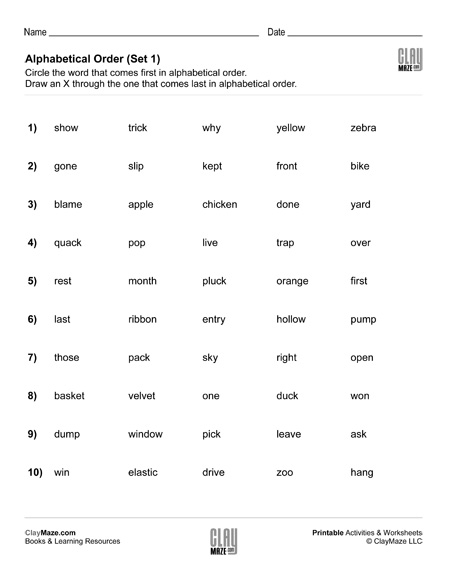
Alphabetical Order Worksheets: Find the First and Last Words
These alphabetical order worksheets give students a new way to practice alphabetizing skills. Instead of sorting a full list of words, each worksheet presents rows of multiple words, and students must identify which word comes first and which comes last
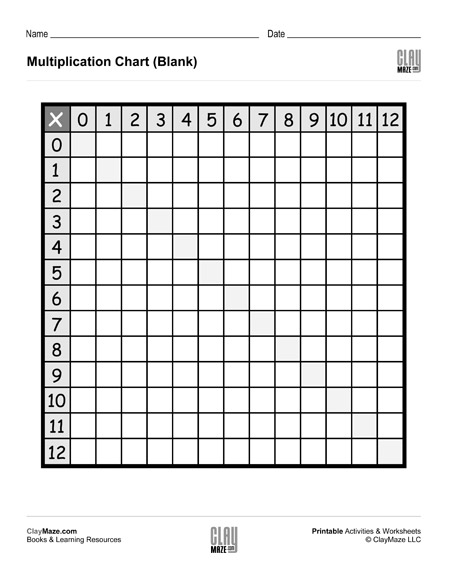
Blank Multiplication Table for Facts Practice
Help your child build multiplication skills with this free math worksheet. This blank multiplication chart for numbers 0-12 is the perfect tool to build confidence and fluency with multiplication facts. What is a Multiplication Chart? A multiplication chart is a
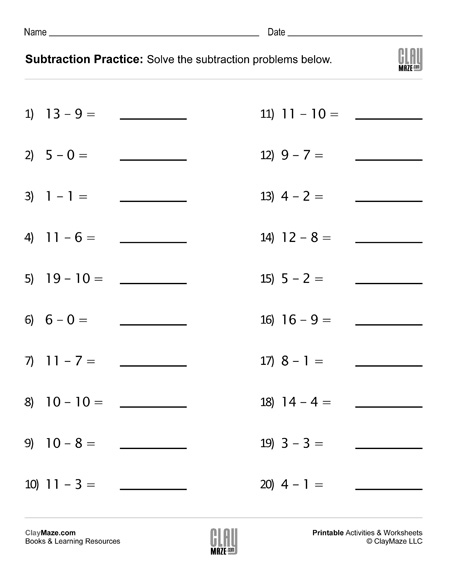
Subtraction Facts Worksheets
Download our free worksheets to help with learning the subtraction facts. Each worksheet has 20 problems. Answers are on the second page. Try our addition and subtraction facts workbook for daily math practice – a great resource for the classroom
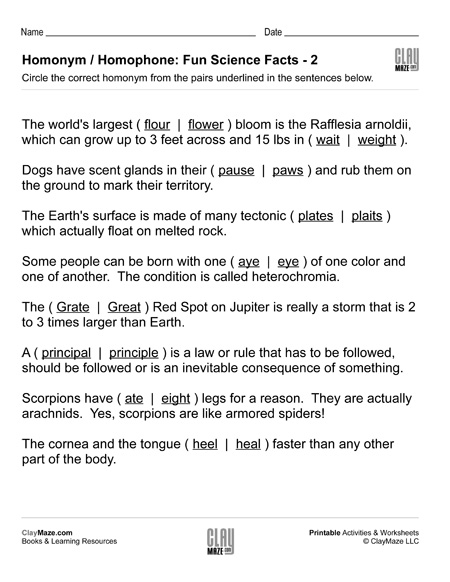
Homonym / Homophone Science Facts, Worksheet 2
Homophones are words that sound the same but have different spellings and meanings. We all make a mistake from time-to-time and interchange a ‘too’ for a ‘two’ or a ‘there’ for a ‘their’, but there are literally hundreds of other