
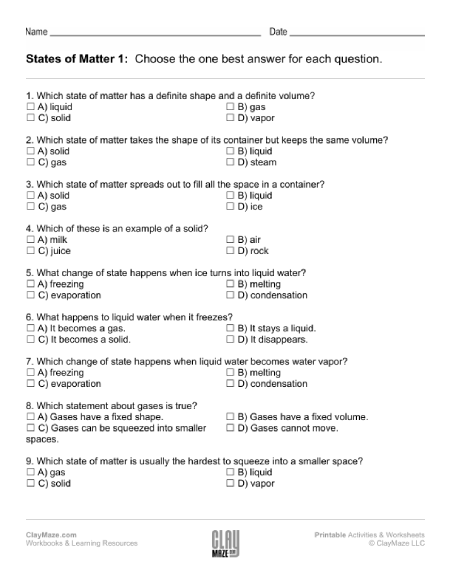
Solids, liquids, and gases are key physical science concepts in Grades 3-4. This States of Matter worksheet set provides structured multiple choice practice focused on identifying the properties of each state of matter and recognizing real-world examples.
This printable set includes two 9-question multiple choice worksheets (18 total questions) and matching answer sheets with answers filled in for easy grading. These worksheets work well for both homeschool science practice and classroom use.
This free worksheet set helps students:
- identify solids, liquids, and gases
- understand shape and volume properties
- identify changes such as melting, freezing, and condensation
- recognize common real-world examples of each state of matter
- practice grade-level science vocabulary using multiple choice questions
Lesson: Understanding the States of Matter
What Is Matter?
Matter is anything that takes up space. Everything around you (your desk, the air you breathe, the water you drink) is made of matter.
Matter comes in three main states:
- Solid
- Liquid
- Gas
Each state has its own special properties.
Solids
A solid has:
- A definite shape (it keeps its shape)
- A definite volume (it takes up the same amount of space)
Examples: A rock, a pencil, a book, ice.
In a solid, the particles are packed tightly together, so they don’t move around much.
Liquids
A liquid has:
- No definite shape (it takes the shape of its container)
- A definite volume (it stays the same amount)
Examples: Water, milk, juice.
If you pour water into a tall glass, it becomes tall. If you pour it into a bowl, it spreads out. But it’s still the same amount of water.
Gases
A gas has:
- No definite shape
- No definite volume
Gases spread out to fill any space they’re in.
Examples: Air, helium in balloons, water vapor.
Changing States of Matter
Matter can change from one state to another when it gains or loses heat.
Melting
- Solid → Liquid
- Example: Ice melting into water
Freezing
- Liquid → Solid
- Example: Water freezing into ice
Evaporation
- Liquid → Gas
- Example: Puddles evaporating on a sunny day
These changes happen because heat affects how fast the particles move.


Related Worksheets

Multi-Step Addition & Subtraction Word Problems (Grades 3–4)
This multi-step addition and subtraction word problems worksheet for Grades 3–4 helps students practice solving real-world math problems that require more than one step. The problems are designed to reflect the type of questions students see in classrooms and on
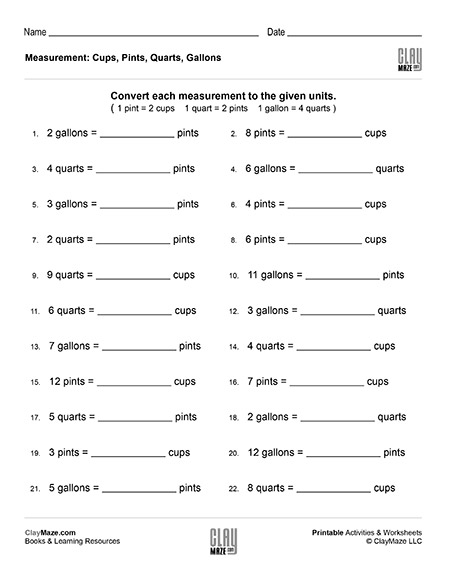
Cups, Pints, Quarts, Gallons Worksheets: Liquid Measurement & Unit Conversions
Master converting units of liquid measurement with this set cups, pints, quarts, and gallons worksheets. These printable pages give students plenty of practice working with capacity, volumes, and real‑world liquid measure conversions using simple multiplication facts up to 12. –
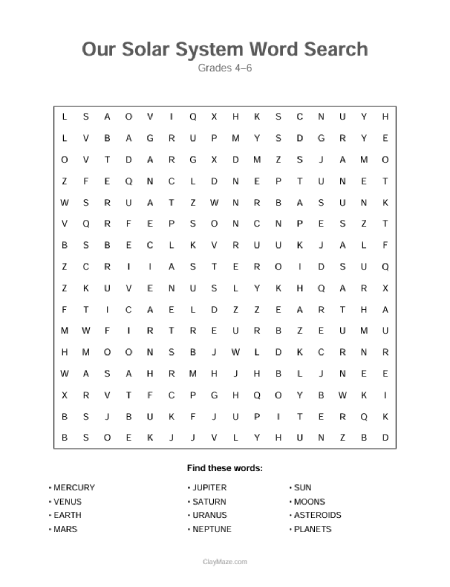
Our Solar System Word Search (Grades 4-6)
This Solar System word search worksheet for Grades 4–6 gives students a fun way to review key space science vocabulary while building focus and spelling skills (includes solutions). Students search for important solar system terms, including the eight planets as
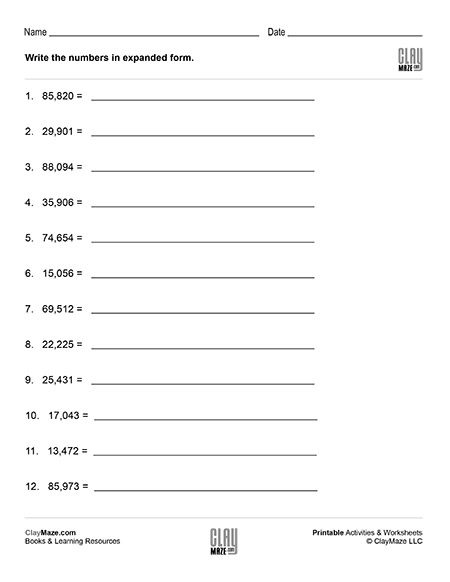
Expanded Form Worksheets: Ten Thousands Place Value
Give students targeted practice with 5‑digit place value using these worksheets up to the ten‑thousands place. Learners break numbers into ten‑thousands, thousands, hundreds, tens, and ones as they rewrite each value in expanded form. This helps them see how large
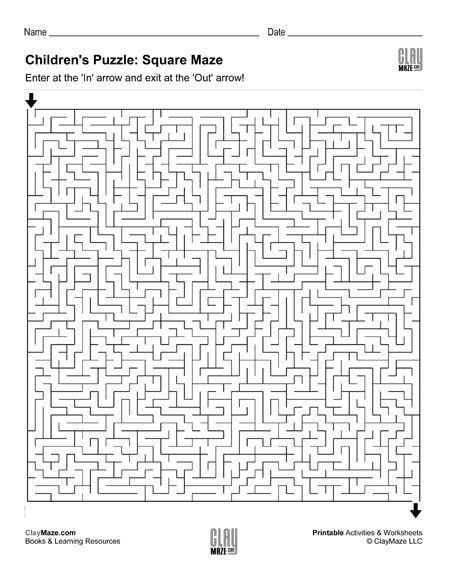
Children’s Puzzle: Square Maze
Feel free to download this and the other free printable mazes and puzzles located on our site and please note, the second page of the PDF is the solution so remember not to peek!
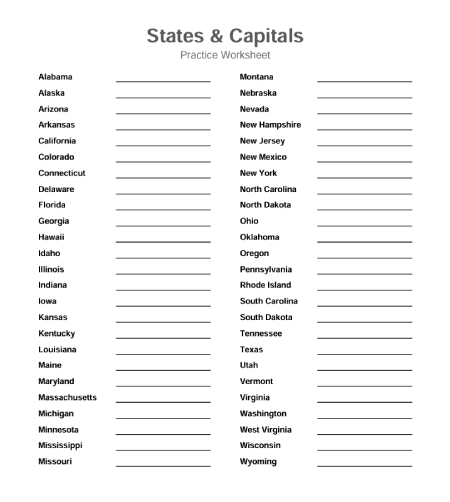
U.S. States & Capitals Worksheet (Grades 4-6)
Learning U.S. states and capitals is a core geography skill in upper elementary school, and this free printable states and capitals worksheet for Grades 4-6 gives students a clear, structured way to study and practice. Designed for classroom and homeschool