
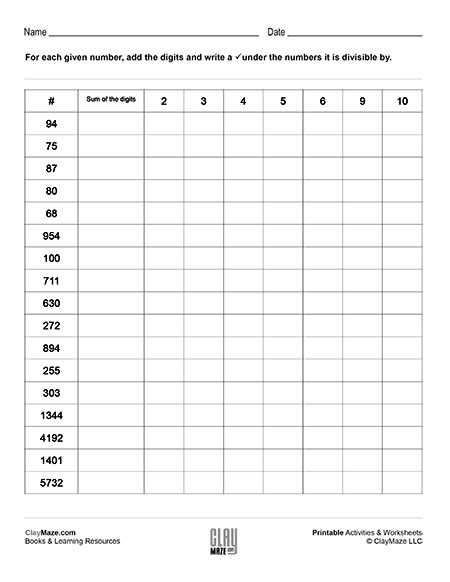
Strengthen number sense with these divisibility rules worksheets. Students practice using rules for 2, 3, 4, 5, 6, 9, and 10, with a helpful first column for adding the digits of each number to check divisibility by 3 and 9. Understanding these rules makes it much easier to factor numbers and simplify fractions, giving learners a clearer path through more challenging math.
Use for the classroom or homeschool. Each worksheet includes an answer key.
Worksheet 1 Worksheet 2 Worksheet 3 Worksheet 4Divisibility rules help students quickly determine whether one number can be divided by another without leaving a remainder. This makes it easier to factor numbers, simplify fractions, and work more efficiently with larger values.
Understanding Divisibility Rules (Lesson)
By using these rules, you can decide if a number is divisible without doing long division.
- Divisible by 2: The number is even – it ends in 0, 2, 4, 6, or 8
- Divisible by 3: Add the digits: if the sum of the digits is divisible by 3, the number is divisible by 3
- Divisible by 4: The last two digits form a number divisible by 4
- Divisible by 5: The number ends in 0 or 5
- Divisible by 6: The number is divisible by both 2 and 3
- Divisible by 8: The last three digits form a number divisible by 8
- Divisible by 9: Add the digits: if the sum of the digits is divisible by 9, the number is divisible by 9
- Divisible by 10: The number ends in 0
Note:
If a number is not divisible by 2, then it is not divisible by 4, 6, 8 or 10.
If a number is not divisible by 3, then it is not divisible by 6 or 9.
Example: Check whether 1,368 is divisible by 2, 3, 4, 5, 6, 9, and 10.
Divisible by 2:
The number ends in 8, so 1,368 is divisible by 2.
Divisible by 3:
Add the digits: 1 + 3 + 6 + 8 = 18.
Since 18 is divisible by 3, 1,368 is divisible by 3.
Divisible by 4:
Look at the last two digits: 68.
Since 68 is divisible by 4, 1,368 is divisible by 4.
Divisible by 5:
The number does not end in 0 or 5, so 1,368 is not divisible by 5.
Divisible by 6:
A number must be divisible by both 2 and 3.
Since 1,368 meets both rules, it is divisible by 6.
Divisible by 9:
Use the digit sum again: 1 + 3 + 6 + 8 = 18.
Since 18 is divisible by 9, 1,368 is divisible by 9.
Divisible by 10:
The number does not end in 0, so 1,368 is not divisible by 10.
For More Divisibility Rules Printables
Download the divisibility rules with examples and an extra practice sheet from our workbook: Mastering Fractions with Factors and Multiples.
For more practice or help with other pre-algebra topics, try our workbooks.

Related Worksheets
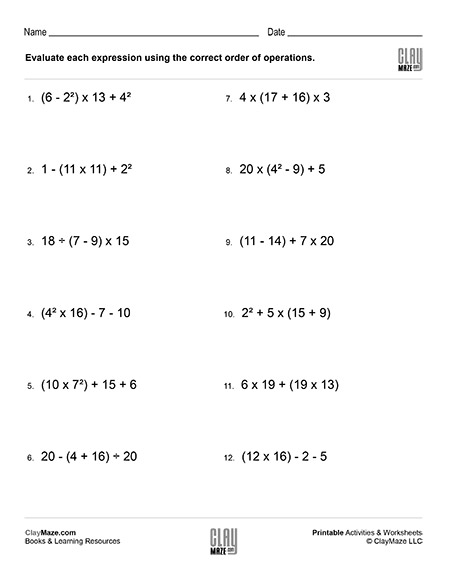
Order of Operations Worksheets (PEMDAS): Single Parentheses
These Order of Operations worksheets are designed to give students practice evaluating math expressions using PEMDAS. Each printable worksheet includes a variety of problems that help reinforce the correct order of operations. They’re designed for use in classrooms or homeschool,
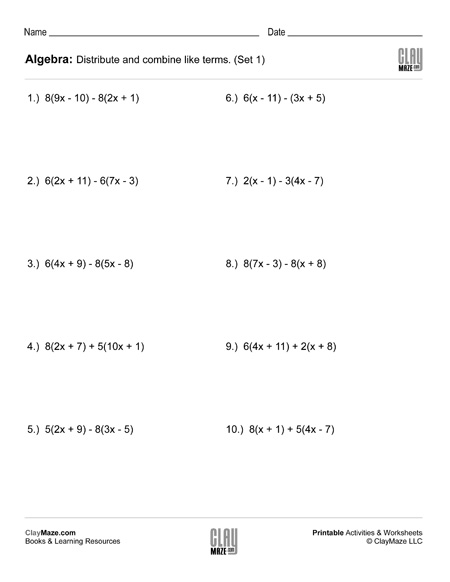
Distributing and Combining Like Terms Worksheets for Pre-Algebra
Download our free worksheets for practice distributing and combining like terms with variables. For more practice or detailed explanation on expressions and equations, try our Pre-Algebra Skill Building Workbook. Topics include: solving 1 step equations and 2 step equations, negative
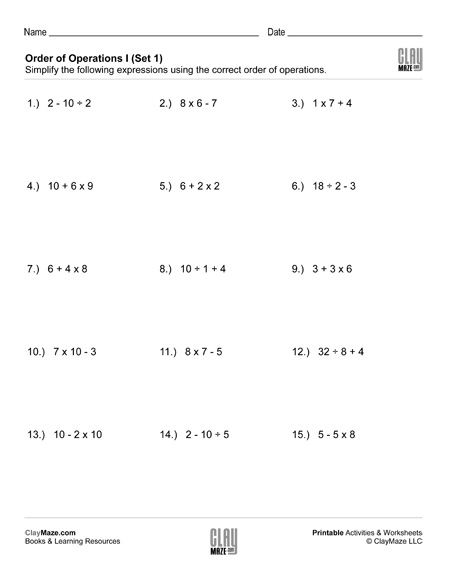
Order of Operations Worksheets: Beginner Level (No Parentheses – 2 Operations)
These worksheets provide practice with the order of operations using straightforward, two‑operation expressions. Each problem includes three numbers and combines addition or subtraction with multiplication or division, giving students a simple introduction to using the correct order of operations. Some
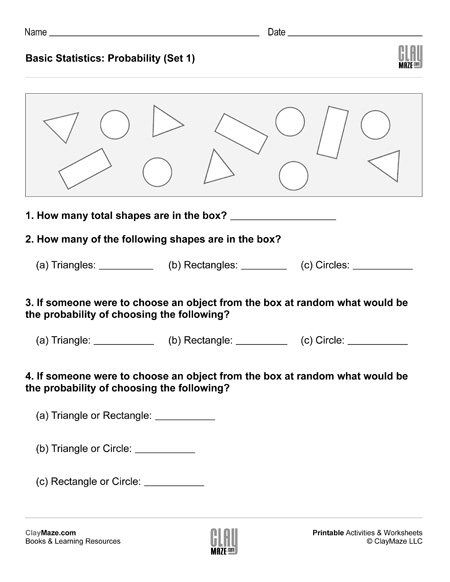
Basic Probability Worksheets
These basic probability worksheets introduce students to the foundations of probability using simple shapes and easy counting tasks. Each worksheet includes a box of shapes and a series of questions that guide students through identifying outcomes, comparing quantities, and calculating
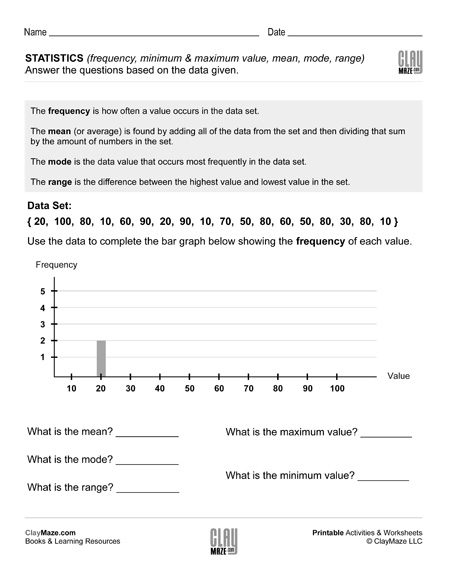
Statistics Worksheets – Mean, Mode, Range, Minimum and Maximum Values
In these statistics worksheets, students are asked to complete the graph using the given data set and find the mean, mode, range, and minimum and maximum values. The frequency is how often a value occurs in the data set.The mean
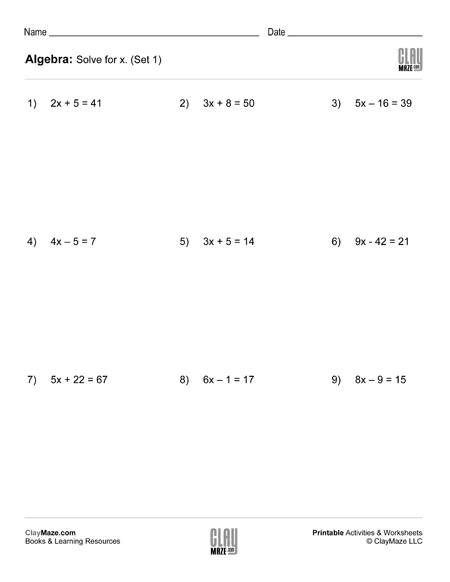
2 Step Equations Worksheets with Answers
These worksheets help students practice solving two‑step equations, an important skill in Pre‑Algebra and Algebra 1. Each problem requires two operations to isolate the variable, usually a combination of addition or subtraction along with multiplication or division. Each worksheet includes