
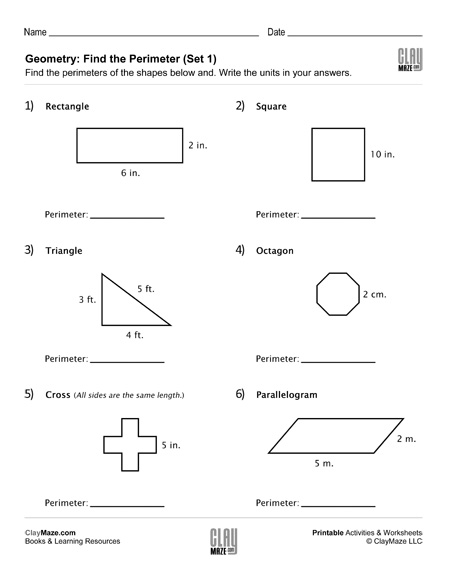
These worksheets help students practice finding the perimeter of shapes by adding the lengths of all the sides. Below you’ll find a quick explanation, formulas, examples, and free printable perimeter practice pages.
What Is Perimeter?
Perimeter is the total distance around the outside of a shape. To find the perimeter, you add the lengths of all the sides together.
Perimeter is measured in units such as inches, centimeters, feet, or meters.
Perimeter Formulas
Here are the most common perimeter formulas students use:
- Square: (Add all four equal sides.)
- Rectangle: (Add the length twice and the width twice.)
- Triangle: (Add all three sides.)
- Any polygon: Add the length of every side.
How to Find the Perimeter
- Identify all the side lengths of the shape.
- Add the lengths together.
- Include the correct unit in your answer.
- If a side is missing, use the shape’s properties to figure it out (for example, opposite sides of a rectangle are equal).
Free Printable Perimeter Worksheets
Worksheet 1 Worksheet 2More Geometry Worksheets
For additional practice with basic geometry skills, you can also use this worksheet on finding missing angles in triangles:
Find the Missing Angle in the Triangles
For more practice or help with other pre-algebra topics, try our workbooks.

Related Worksheets
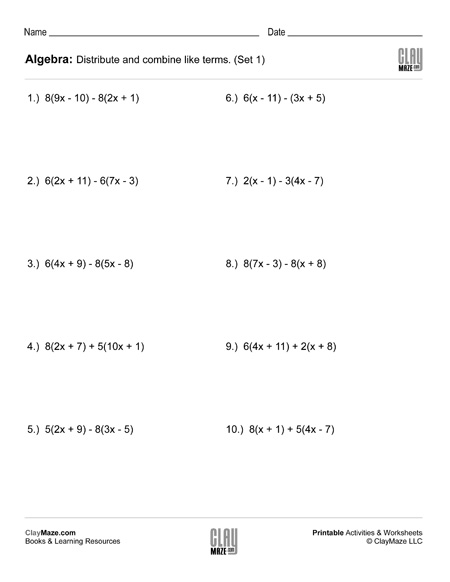
Distributing and Combining Like Terms Worksheets for Pre-Algebra
Download our free worksheets for practice distributing and combining like terms with variables. For more practice or detailed explanation on expressions and equations, try our Pre-Algebra Skill Building Workbook. Topics include: solving 1 step equations and 2 step equations, negative
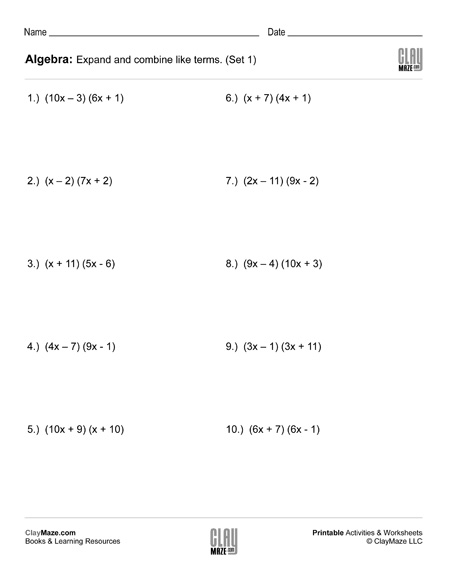
Expanding and Combining Like Terms Worksheets for Pre-Algebra
Download these free printable pre algebra worksheets for practice expanding and combining like terms. For more practice or detailed explanation on expressions and equations, try our Pre-Algebra Skill Building Workbook. Topics include: solving 1 step equations and 2 step equations,
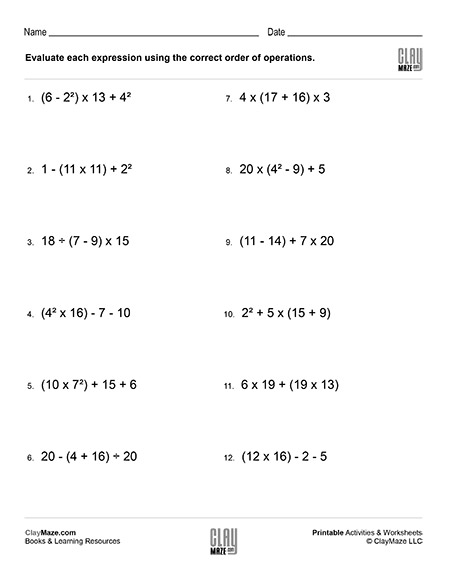
Order of Operations Worksheets (PEMDAS): Single Parentheses
These Order of Operations worksheets are designed to give students practice evaluating math expressions using PEMDAS. Each printable worksheet includes a variety of problems that help reinforce the correct order of operations. They’re designed for use in classrooms or homeschool,
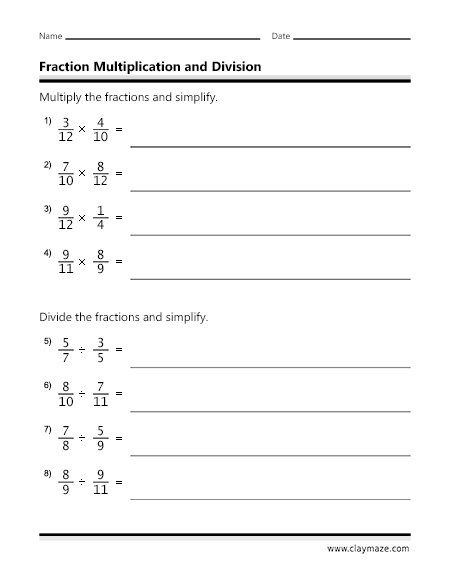
Multiplying and Dividing Fractions – Worksheets with Answers
Practice multiplying and dividing fractions with these worksheets. These are from our printable book on Teachers Pay Teachers on fraction multiplication and division.
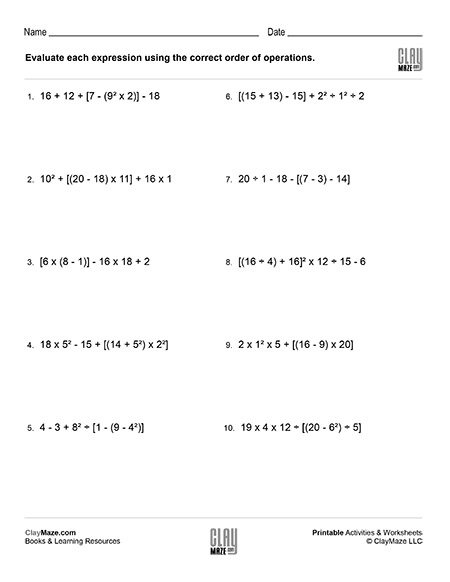
Order of Operations Worksheets (PEMDAS): Nested Parentheses
These order of operations worksheets with nested parentheses give students practice working through more complex expressions using PEMDAS. Each printable worksheet includes problems that feature two or more layers of parentheses, helping learners apply the order of operations. These worksheets
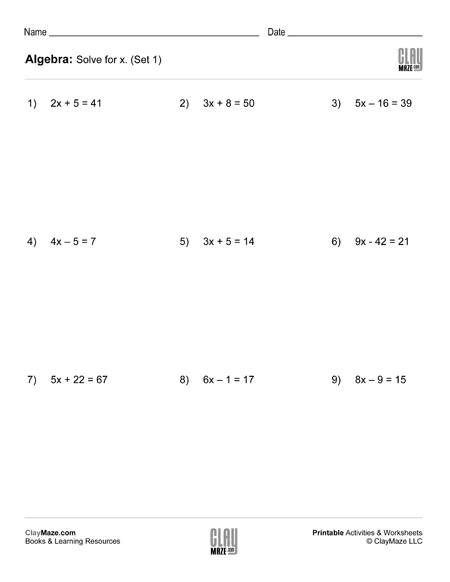
2 Step Equations Worksheets with Answers
These worksheets help students practice solving two‑step equations, an important skill in Pre‑Algebra and Algebra 1. Each problem requires two operations to isolate the variable, usually a combination of addition or subtraction along with multiplication or division. Each worksheet includes