
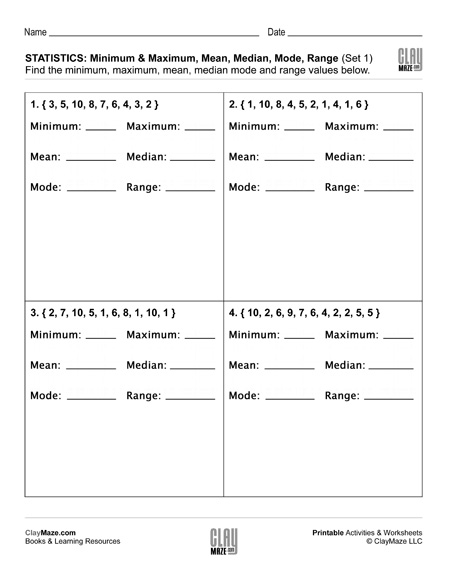
These free printable statistics worksheets help students practice calculating the minimum, maximum, mean, median, mode, and range for different sets of numbers. Each worksheet includes four data sets and space for students to show their work. These printables are ideal for grades 4-7, homeschool lessons, tutoring, or classroom warm‑ups.
What Students Practice on These Worksheets
- Identifying the minimum and maximum values
- Finding the mean (average)
- Determining the median (middle value)
- Identifying the mode (most frequent value)
- Calculating the range (difference between max and min)
These skills form the foundation of descriptive statistics and prepare students for more advanced math concepts.
Each worksheet includes:
- 4 sets of numbers
- Space to calculate all six statistics
- Clear formatting for easy grading
- Printable PDF format
- Answer key
Statistics Terminology and Examples
Minimum
The minimum is the smallest number in a data set. Example: In 3, 8, 2, 10 → the minimum is 2.
Maximum
The maximum is the largest number in a data set. Example: In 3, 8, 2, 10 → the maximum is 10.
Mean
The mean is the average of the numbers. To find it, add all the numbers and divide by how many numbers there are. Example: (3 + 8 + 2 + 10) ÷ 4 = 5.75
Median
The median is the middle number when the data is arranged from smallest to largest.
- If there is an odd number of values → the middle one is the median.
- If there is an even number of values → average the two middle numbers.
Example: Sorted: 2, 3, 8, 10 → median = (3 + 8) ÷ 2 = 5.5
Mode
The mode is the number that appears most often in the data set. A set can have:
- one mode
- more than one mode
- no mode (if all numbers appear the same number of times)
Example: 3, 8, 8, 2, 10 → mode = 8
Range
The range shows how spread out the numbers are. To find it, subtract the minimum from the maximum.
Example: 10 − 2 = 8
Example Problems
Date Set: {4, 7, 7, 10, 12}
- Minimum: 4
- Maximum: 12
- Mean: (4 + 7 + 7 + 10 + 12) ÷ 5 = 8
- Median: 7
- Mode: 7
- Range: 12 – 4 = 8
Data Set: {15, 20, 22, 22, 30, 31}
- Minimum: 15
- Maximum: 31
- Mean: 23.3
- Median: (22 + 22) ÷ 2 = 22
- Mode: 22
- Range: 31 – 15 = 16
Related Worksheets
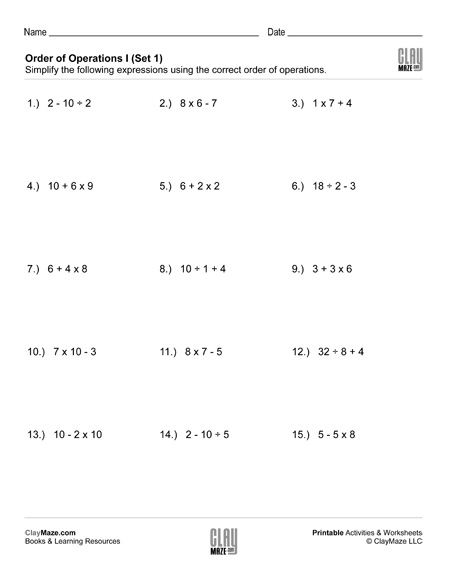
Order of Operations Worksheets: Beginner Level (No Parentheses – 2 Operations)
These worksheets provide practice with the order of operations using straightforward, two‑operation expressions. Each problem includes three numbers and combines addition or subtraction with multiplication or division, giving students a simple introduction to using the correct order of operations. Some
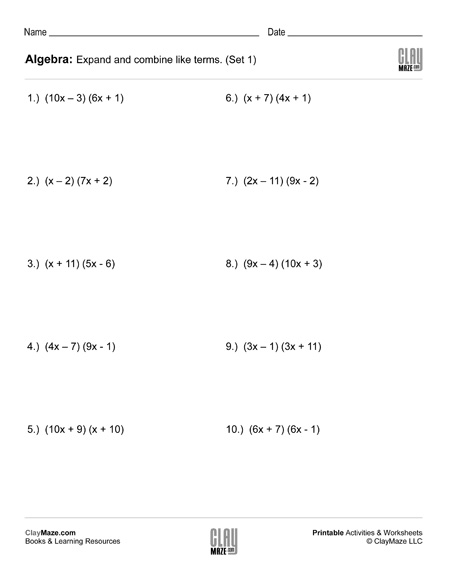
Expanding and Combining Like Terms Worksheets for Pre-Algebra
Download these free printable pre algebra worksheets for practice expanding and combining like terms. For more practice or detailed explanation on expressions and equations, try our Pre-Algebra Skill Building Workbook. Topics include: solving 1 step equations and 2 step equations,
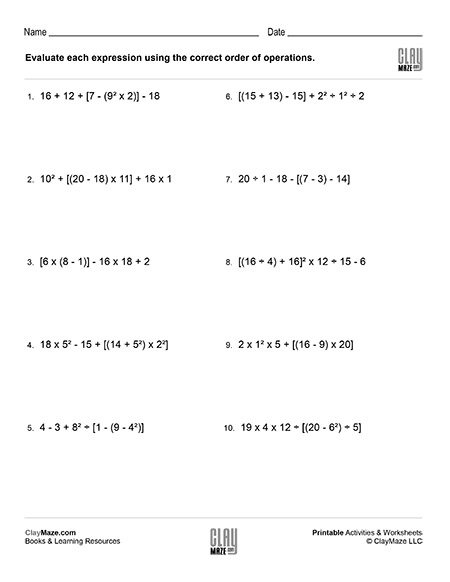
Order of Operations Worksheets (PEMDAS): Nested Parentheses
These order of operations worksheets with nested parentheses give students practice working through more complex expressions using PEMDAS. Each printable worksheet includes problems that feature two or more layers of parentheses, helping learners apply the order of operations. These worksheets
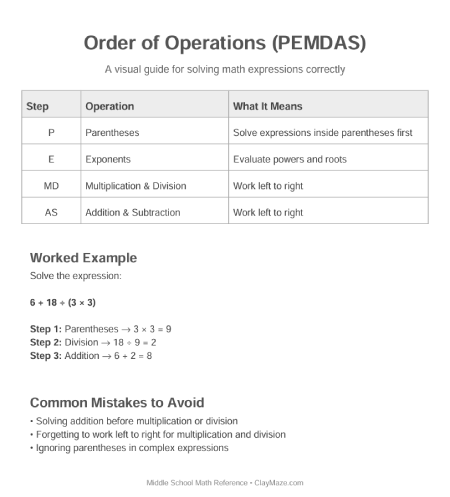
Order of Operations (PEMDAS) – Reference Sheet
This Order of Operations (PEMDAS) printable is a visual reference designed to help students understand the correct sequence for solving math expressions. The guide clearly breaks down each step – Parentheses, Exponents, Multiplication and Division, and Addition and Subtraction –
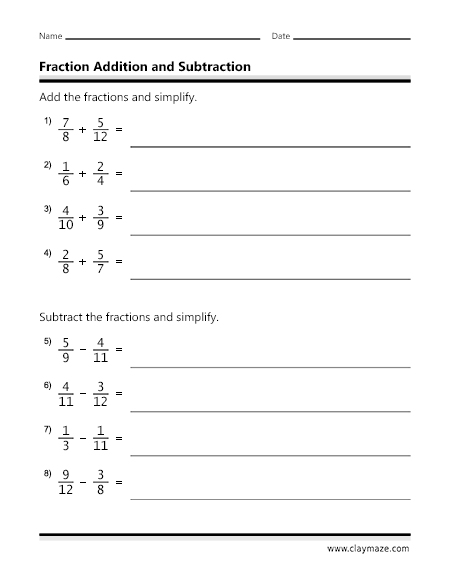
Adding and Subtracting Fractions with Unlike Denominators – Worksheets with Answers
Download these free, printable PDF worksheets for adding and subtracting fractions with unlike denominators, complete with answer keys. Each problem involves adding or subtracting fractions with unlike denominators. Students are given horizontal space to rewrite and solve the expressions using
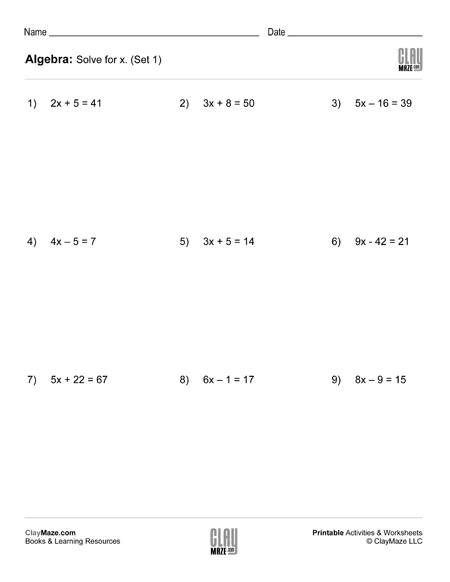
2 Step Equations Worksheets with Answers
These worksheets help students practice solving two‑step equations, an important skill in Pre‑Algebra and Algebra 1. Each problem requires two operations to isolate the variable, usually a combination of addition or subtraction along with multiplication or division. Each worksheet includes