
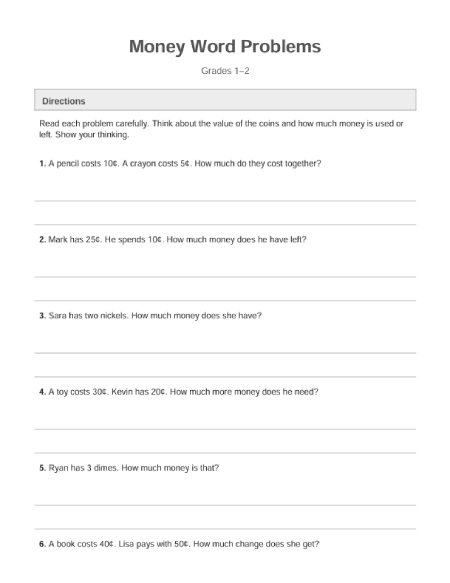
This money word problems worksheet for Grades 1–2 helps students practice using coins and understanding simple money situations they see in everyday life.
The problems focus on identifying the value of pennies, nickels, and dimes, adding and subtracting money amounts, and figuring out whether there is enough money to buy an item. Students are encouraged to think through each situation and show their work, not just give an answer.
This printable is a great fit for:
- early elementary money lessons
- homeschool math practice
- reinforcing coin values and money word problems
- classroom review or independent work
The worksheet includes 10 money word problems, space for students to show their thinking, and a complete answer key. The simple, ink-friendly layout makes it easy to print and use.
Download Printable PDF

Related Worksheets
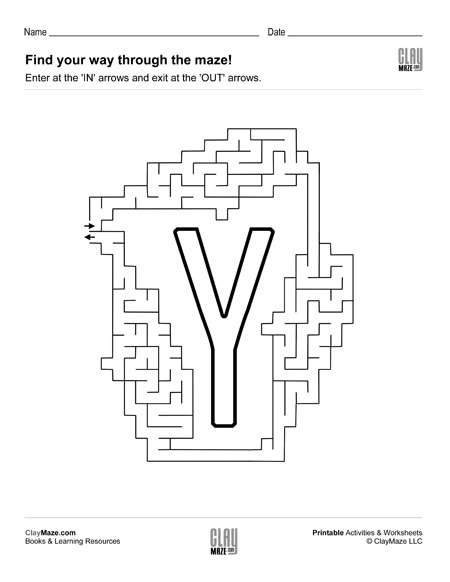
Alphabet Maze Worksheet – The Letter Y
Y is the letter of the day! Download our free, printable alphabet maze activity sheets. Mazes are not only fun for children but help to develop executive functioning processes. These decision-making processes include organizing, planning, time management skills, memory and
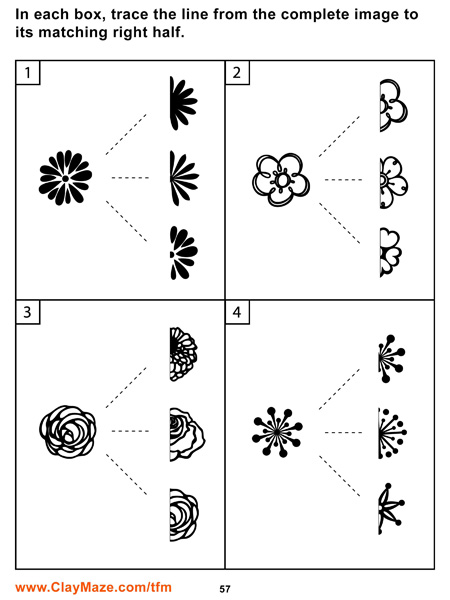
Pattern Recognition Matching
Whether our children are facing a career in accounting, medicine, science or art, they will be faced with a tremendous amount of data – an amount of data that could never have been predicted when our educational curriculum were developed
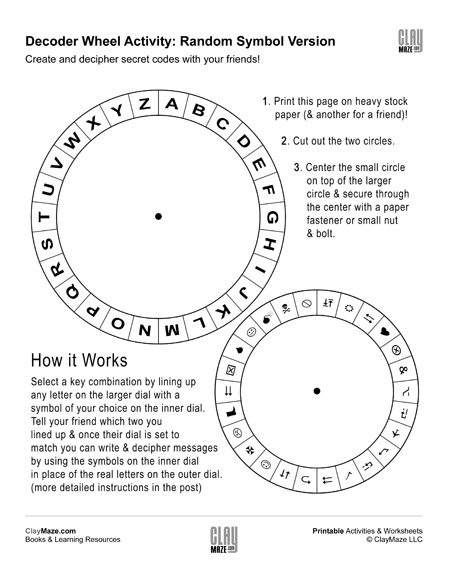
Spy Decoder Wheel – Random Symbol Version
This template is the Symbol Version of our Alphabet Decoder Wheel. There are three decoder wheels in all allowing for the coding and deciphering of secret messages using random alphabet letters, symbols or even your very own code! See the
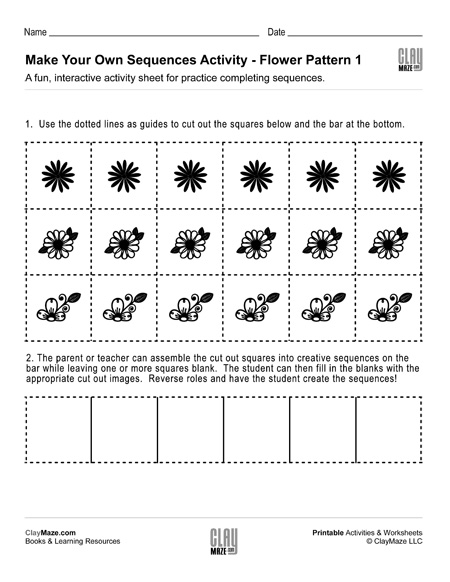
Make Your Own Sequences Activity – Flower Pattern 1
This activity is a fun twist on the basic challenge of completing sequences. The child can use the dotted lines as guides to cut out the shape squares and the bar at the bottom of the page. The parent or
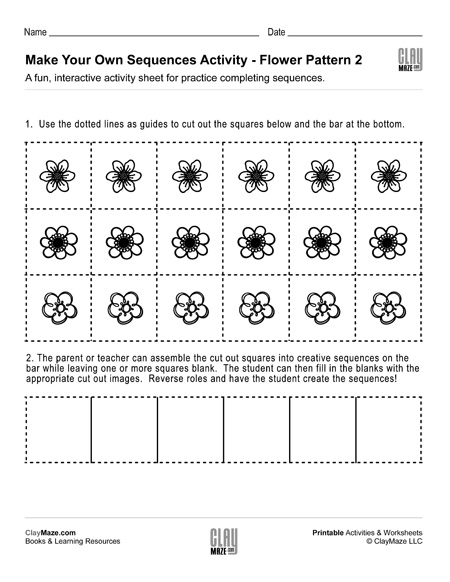
Make Your Own Sequences Activity – Flower Pattern 2
Pattern recognition and sequences play a big role in children’s learning. This particular activity is a little more interactive and allows children to not only decode and complete the missing sequences but participate in their design. The child can cut
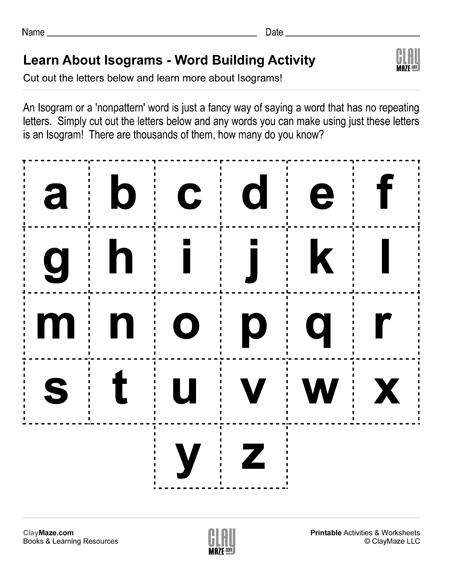
Learn About Isograms – Word Building Activity
An Isogram, otherwise known as a “nonpattern word”, is just a fancy way of referring to a word or phrase that has no repeating letters. This particular activity not only introduces the child to Isograms but includes a little general