Why Summer Is the Perfect Time to Review Fractions (Grades 4–6)
Summer is a great opportunity for kids to relax, but it’s also the time when many students lose some of the math skills they worked hard to build during the school year. Research shows that students can forget 20–30% of their math knowledge over a long break – a phenomenon often called the summer slide. Fractions are especially vulnerable because they require consistent practice to stay sharp.
Fractions also happen to be the #1 skill students struggle with when they return to school, especially in grades 4–6. Concepts like equivalent fractions, simplifying, and adding or subtracting with unlike denominators fade quickly without reinforcement. When these skills weaken, everything that comes next (decimals, ratios, and eventually pre‑algebra) becomes harder than it needs to be.
The good news is that keeping fraction skills fresh doesn’t require long lessons or complicated activities. Just 10 to 15 minutes a day can make a huge difference. A quick warm‑up, a short worksheet, or a simple real‑life fraction activity is enough to help students maintain confidence and stay ready for the more advanced math they’ll encounter in the fall.
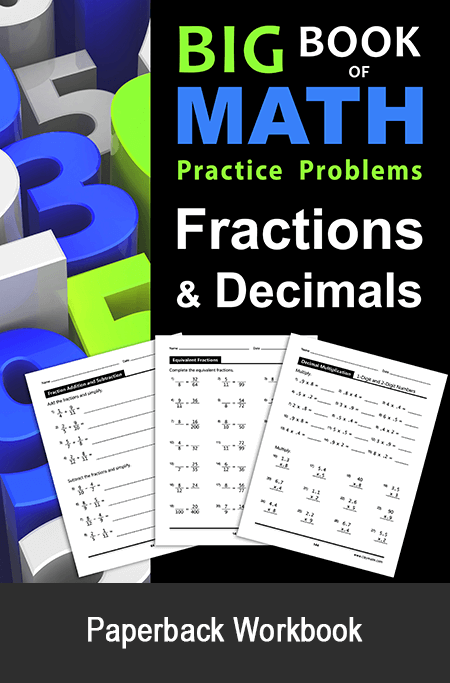
If you want a simple, structured way to keep fraction skills sharp, our Big Book of Fractions & Decimals offers plenty of ready‑to‑use practice pages for summer review. And if you’re looking for a more instructional workbook – with clear explanations, step‑by‑step examples, and guided practice – our Mastering Fractions with Factors and Multiples workbook is a great choice for building deeper understanding before pre‑algebra.
Essential Fraction Skills for Pre‑Algebra Readiness
Before students move into pre‑algebra, they need a strong foundation in the fraction skills taught throughout grades 4-6. These concepts show up again and again in middle‑school math, and students who are confident with fractions have a much easier time with ratios, decimals, equations, and multi‑step problem solving.
These are the fraction skills that matter most for pre‑algebra success:
- Understanding numerator vs. denominator
Students should know what each part represents and how it affects the size of a fraction. - Equivalent fractions
Recognizing and generating equivalent fractions is essential for comparing, simplifying, and adding fractions. - Simplifying fractions
Students should be comfortable using factors and multiples to reduce fractions to simplest form. - Comparing fractions
Whether using common denominators, benchmarks, or number lines, students need strategies to compare fractions accurately. - Adding and subtracting fractions
Both like and unlike denominators matter here. This is one of the biggest skill gaps students face after summer break. - Multiplying fractions
This includes multiplying fractions by whole numbers and multiplying two fractions together. - Dividing fractions
A key 5th‑grade standard that often gets rusty without practice. - Converting between fractions and decimals
A critical bridge skill that leads directly into ratios, percentages, and algebraic thinking. - Factors and multiples
This is the “hidden engine” behind simplifying fractions, finding common denominators, and working efficiently with multi‑step problems.
For guided instruction – especially with factors, multiples, and step‑by‑step fraction strategies – our Mastering Fractions with Factors and Multiples workbook offers clear explanations, examples, and practice pages designed to build deep understanding before pre‑algebra.
Quick Daily Fraction Warm‑Ups
A few minutes of quick, low‑pressure practice can make a big difference – especially for students in grades 4-6 who are getting ready for pre‑algebra. These simple warm‑ups fit easily into busy summer days and help reinforce the fraction concepts students tend to forget most.
- Real‑life fraction spotting
Encourage kids to notice fractions in everyday life—measuring cups while cooking, dividing a pizza, splitting a snack, or comparing portions. These quick conversations help students connect fractions to real situations. - Quick fraction comparison challenges
Give your child two fractions and ask which is larger. They can use benchmarks (like ½), common denominators, or number lines. This builds number sense and strengthens mental math. - Decimal conversion mini‑drills
Start with fractions that connect easily to money – like ¼ (25¢), ½ (50¢), and ¾ (75¢). Show your child how these amounts match the decimals 0.25, 0.50, and 0.75. Once they see the pattern, try a few new fractions together. - Number “building block” warm‑ups
Choose a number and ask your child to name smaller numbers that fit into it evenly. This helps them understand how to simplify fractions and find common denominators without needing a long lesson.
If your child is ready for more structured warm‑ups that bridge fractions and early algebra, our Pre‑Algebra Skill Building Workbook includes short, daily practice pages designed to strengthen the exact skills students need for middle‑school math.
Keep Fraction Skills Fresh With Small Daily Habits
Summer doesn’t have to mean losing hard‑earned math skills. With just a few light, consistent habits, students in grades 4-6 can keep their fraction knowledge strong and head into the new school year feeling confident. Short warm‑ups, quick real‑life conversations, and simple practice pages are all it takes to prevent the “summer slide” and keep those essential pre‑algebra readiness skills sharp.
The key is to keep things light, keep them consistent, and remember that fractions don’t have to be stressful. A little practice each day goes a long way and summer is the perfect time to build confidence without the pressure of homework or tests.
If you’re ready for a full summer fraction plan, check out our Big Book of Fractions & Decimals for easy, ready‑to‑use practice pages. And if your child needs more step‑by‑step instruction, our Mastering Fractions with Factors and Multiples can help.
For more practice or help with fractions, try our workbooks.